
Clearwater County Release Meanings
A release is a recorded end to one custody episode. It does not always mean that a person walked into the community. Someone may leave Clearwater County Jail after bond, an own-recognizance order, dismissal, time served, or completion of a county sentence. The same person may instead be transferred to the Idaho Department of Correction, another county, the U.S. Marshals Service, or immigration custody. The sheriff's movement entry should identify the release type, reason, or receiving agency. That detail prevents a transfer from being called a community release.
Clearwater County released inmates also have different records based on who held them. The sheriff keeps the county booking and custody movement. IDOC keeps state sentence, prison, parole, probation, and discharge data. A court file explains the legal order, but it is not the jail's door log. VINE can report an agency-fed custody change, yet it is not a certified release record. Each source answers a narrow question, so a sound result pairs the status with the right custodian.
| Exit type | What it means | Best next record |
|---|---|---|
| Bond or recognizance | Pretrial custody ends while the case stays open | Sheriff movement record and iCourt bond order |
| Time served or sentence complete | Credit or the local term supports release | Judgment plus dated jail exit |
| Parole | State prison custody changes to supervised community status | IDOC detail and Commission action |
| Probation | A court orders community supervision, sometimes without prison | Court order and the proper supervision office |
| Transfer or detainer | One agency's custody ends while another begins | Receiving-agency notation and that agency's locator |
Clearwater County Release Record Fields
A focused Clearwater County release request asks for an existing booking sheet, custody history, or movement entry. Give the full name, a narrow booking date range, and the booking or case number when known. Ask for the admission and exit timestamps, the type of exit, and the destination. A booking photograph may be requested as a related record, but the image proves only that a photo was taken at booking. The dated movement entry shows what happened at the end of that custody episode.
| Field | What it shows |
|---|---|
| Booking number | Connects the person to the correct jail episode |
| Admission date and time | Marks the start of recorded custody |
| Release date and time | Marks the recorded exit from that custodian |
| Release type or reason | Distinguishes bond, time served, dismissal, order, or transfer |
| Destination or receiving agency | Shows whether another agency took custody |
| Case, charge, bond, or order reference | Links the movement to its legal basis |
| Holds or detainers | Identifies another claim on custody that can delay a door release |
Request Clearwater County Release Records
The official starting point is the Clearwater County Document Center entry for the Sheriff's Office public-record request. The current linked form was not consistently available during research, so use the document center and the sheriff's contact as the live fallback. Submit a narrow request to the Clearwater County Sheriff at 150 Michigan Avenue, PO Box 724, Orofino, ID 83544. Administrative questions go to 208-476-4521; immediate custody questions go to the jail at 208-476-8903.
The request should seek records that already exist. Do not ask staff to create a new 24-hour list, explain motives, or resolve a theory. Idaho law permits a written request that identifies the subject and date range, and it permits electronic request and delivery. Ask for an estimate before work exceeds a chosen amount. Clearwater County publishes no universal price for a release record.
- Confirm the likely custodian: the sheriff for the county jail or IDOC for a state prison event.
- Identify the person, booking period, case number, and desired electronic format.
- Request the booking sheet, custody movement, exit date and time, exit type, destination, and photo if releasable.
- Ask for an itemized estimate before chargeable search, review, redaction, or copying work begins.
- Save the response, including any redaction or denial citation, and compare it with the court or IDOC record.
The Idaho Public Records Act access and fee rules generally give an Idaho resident the first two labor hours and first 100 paper pages without a fee unless another law applies. Qualifying extra work can be charged at actual allowable cost. Nonresident requests may be charged actual costs under the current rules. These are statutory limits, not a promise that every request is free.
Clearwater Release Timing and Access
Under Idaho Code section 74-103, a resident request is generally granted or denied within three working days. Written notice may extend production, usually no later than ten working days. The amended nonresident schedule allows up to 21 days for a grant or denial and up to 35 days when retrieval takes more time. A denial should identify its legal basis and review rights. Court files follow court access rules rather than the executive-agency timetable.
No official Clearwater County page states how long a released booking stays online because the sheriff does not publish a historical inmate archive. Public access can also change when a record contains juvenile, sealed, medical, victim, security, or other exempt material. Idaho's Clean Slate process shields qualifying court records from public view under limited conditions; it does not destroy every underlying record. A missing iCourt result can therefore reflect shielding, not proof that no case or custody event existed.
- Discharge
- Completion of the correctional jurisdiction shown by the responsible agency.
- Time served
- A judgment that credits enough custody time to satisfy the stated jail term.
- Detainer
- A request or legal basis for another agency to hold or take the person.
- Parole
- Conditional release from state prison custody to community supervision.
- Probation
- Court-ordered community supervision that may follow jail or occur without prison.
Visiting Clearwater County Jail
The official Clearwater County Jail page places the jail on the second floor of the county courthouse. Weekday visitors use the front doors and go upstairs. On Saturdays, Sundays, and holidays, the published access route is the elevator beneath the courthouse. These are building-entry directions, not a release schedule or a stated exit point. Call 208-476-8903 before traveling, especially when the purpose is to meet someone or confirm that processing is complete.
The official jail page also shows why it is the right local starting point and why it is not a release feed.
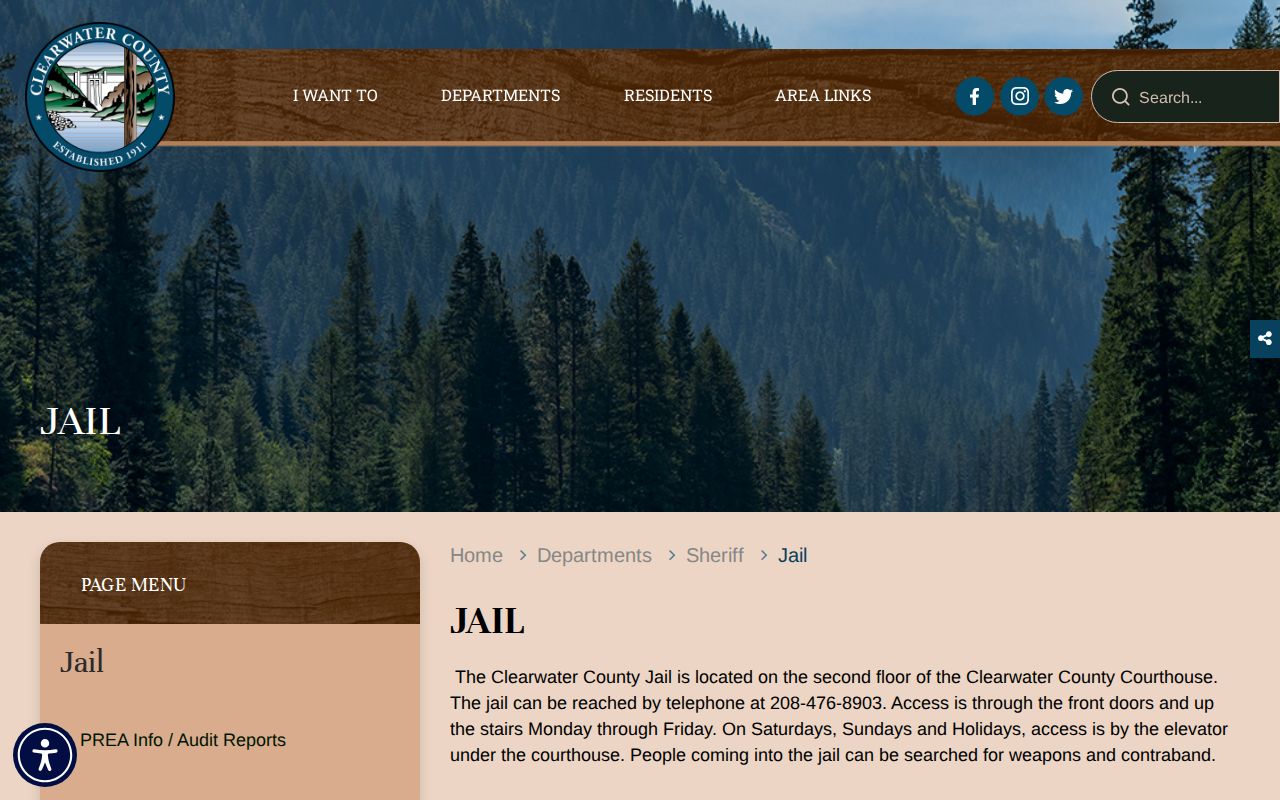
The page supplies facility access and contact information but no named current-inmate cards, past-inmate archive, release timestamp, or 24-hour and 72-hour release controls.
Clearwater Court and Release Records
The courthouse and jail share the 150 Michigan Avenue location, but their records serve different roles. Idaho iCourt can show a bond order, dismissal, judgment, commitment, probation order, warrant, or sentence. The sheriff's custody movement shows whether and when jail staff completed an exit or transfer. A court-authorized release can coexist with another hold, so the order alone does not prove a completed door release.
Search by the exact case number when possible. Read the docket in date order. If an online event is abbreviated, request the underlying document from the Clearwater County court clerk at 150 Michigan Avenue, Room 201, PO Box 586, Orofino, ID 83544, telephone 208-476-5615. Then match the order to the sheriff's dated movement. This paired record separates legal authority from physical custody action.
The official Idaho court Smart Search is the online index for that case review.
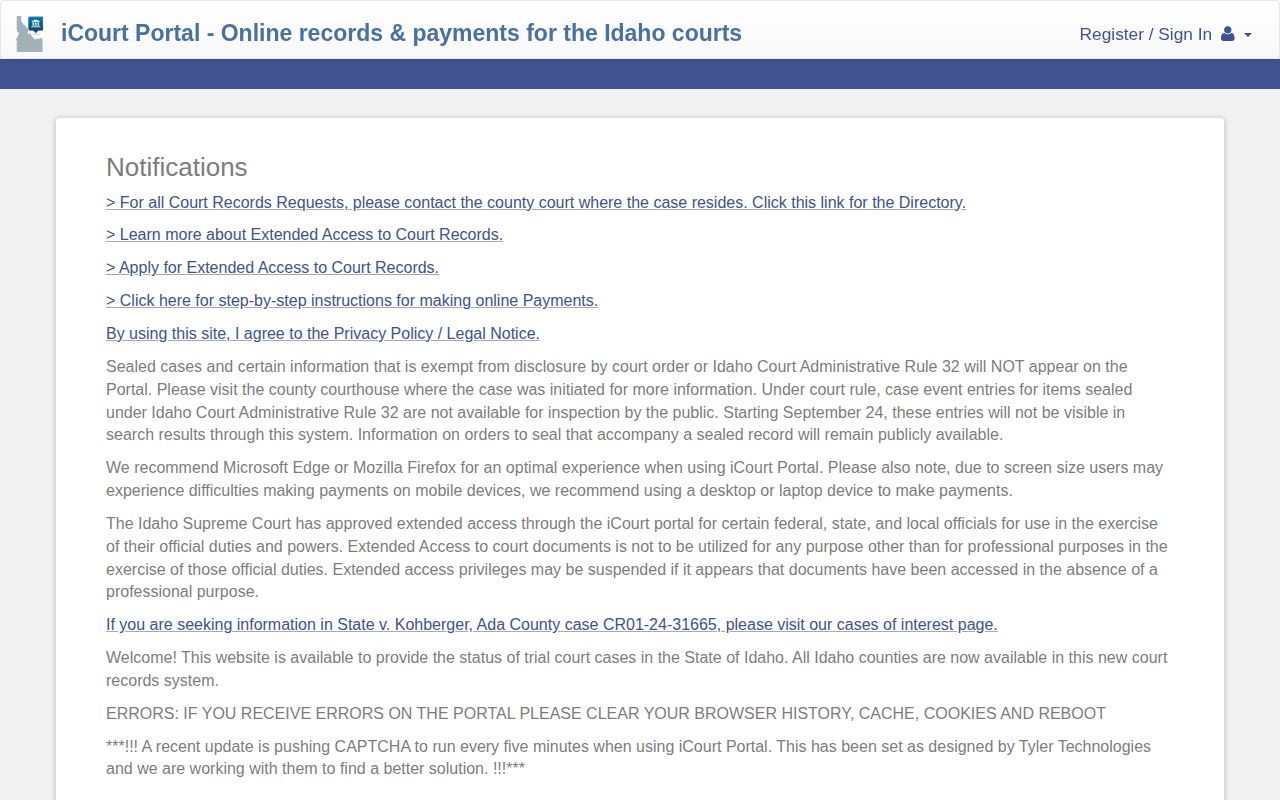
Smart Search is a starting index. The clerk's copy of the order and the custodian's movement entry provide the stronger document chain.
Find Clearwater County Released Inmates
Start with identity and the last known custodian. A person absent from current custody may have been released, but may also have been sent to IDOC, another county, federal custody, immigration custody, or medical care. Clearwater County does not publish an official recent-release feed, so a negative web search cannot answer the question. Use the following chain and stop only when a dated record identifies the event.
- Call Clearwater County Jail for present custody and ask whether the recorded exit was a release or transfer.
- Request the sheriff's movement or release record for the named booking and date range.
- Search IDOC when a state commitment, parole, probation, or prison history is possible.
- Review iCourt for the bond, dismissal, judgment, commitment, warrant, or probation order.
- Use VINE for a person-specific status or notification lead, then confirm with the named agency.
- Use BOP, USMS, or ICE tools only when federal or immigration facts support that route.
For a same-day overview, the 24-Hour Releases page explains the local fallback. The 72-Hour Releases page addresses a weekend or three-day span. Neither page substitutes an unofficial arrest list for a sheriff release record.
IDOC Clearwater Release Search
The IDOC Resident/Client Search covers people incarcerated, on court probation, or on parole. It also retains names of people who served IDOC time and satisfied their sentence, though convictions no longer display after satisfaction. Search by at least two characters of the last name or three digits of an IDOC number. Add the first name, compare birth year and IDOC number, and open the detail only after separating namesakes.
| IDOC field | How to read it |
|---|---|
| In custody | Current IDOC jurisdiction and a listed location |
| In community | Outside prison under an active IDOC relationship, not full discharge |
| Released to Supervision | The most recent placement on supervision by a court or Commission |
| Sentence Satisfaction Date | The sentence endpoint shown, not necessarily a prison exit date |
| Discharged plus date | The displayed completion date for IDOC jurisdiction |
| Active Bench Warrant | An unresolved enforcement status, not a clean discharge |
IDOC says the data updates daily, not in real time. The official IDOC results view demonstrates the discharged-status label used for a completed state case.
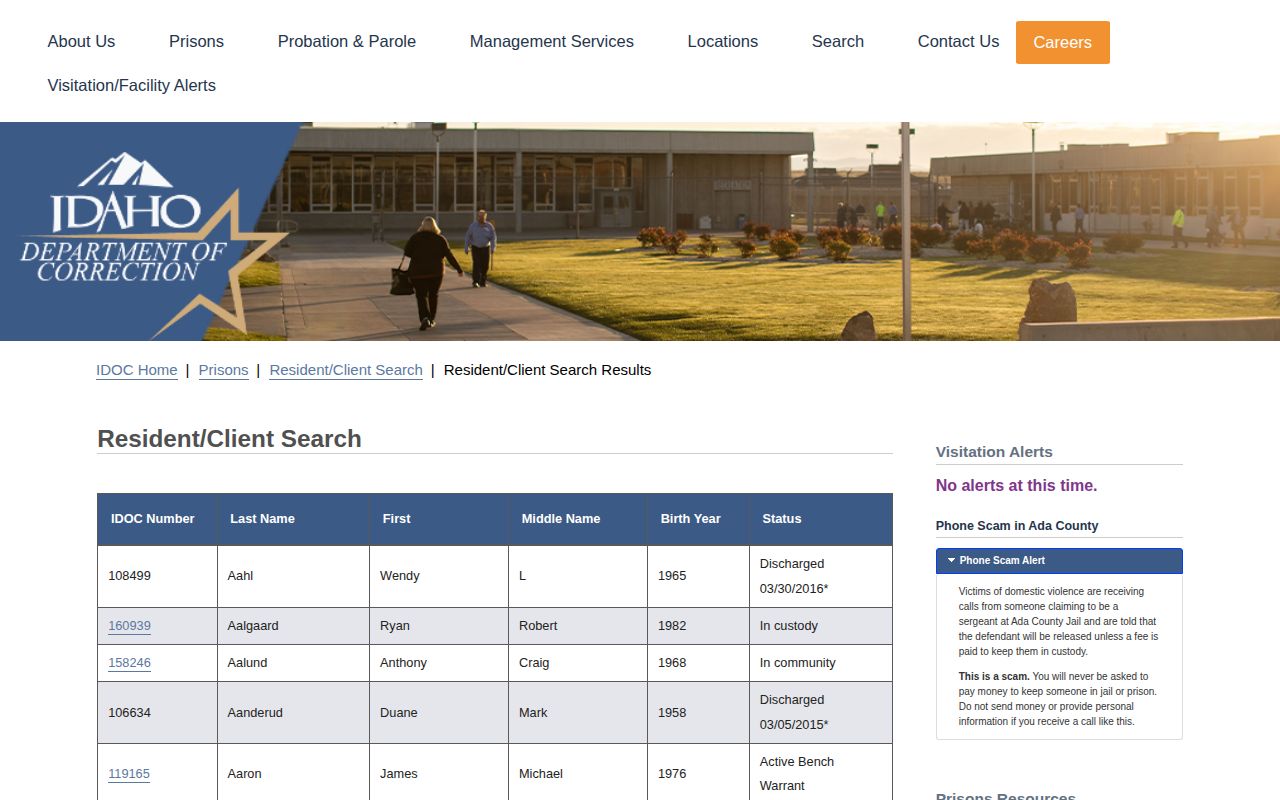
A discharged result is stronger completion evidence than roster absence, but the IDOC number and court case are still needed for historical detail.
Correct Clearwater Release Information
IDOC separates a public-display problem from a request for formal records. Use the Request for Information route linked by Resident/Client Search when a status, date, or other public field appears wrong. Provide the judgment or other source record that supports the correction. For sentence calculations, judgments, retained-jurisdiction or jail credit, parole forfeiture, and historical release records, contact IDOC Sentencing Records.
A formal public-record request goes through the IDOC JustFOIA portal. Ask for the release or discharge record, sentence computation, parole event, and a releasable identifying photo only if relevant. The public search is useful for status, while the formal channel supplies the underlying record. Choosing the right route can prevent a correction request from being treated as a broad records search.
Note: A displayed date dispute should be supported by the judgment or agency record, not by a private estimate.
Clearwater Release Supervision and Alerts
An IDOC detail marked In community may show the supervising district, officer, phone, active sentence rows, and Released to Supervision date. Adult felony parole and probation fall within IDOC's system. A separate Clearwater County Probation Services office supervises local adult misdemeanor cases under the magistrate court, as well as its stated juvenile work. The court disposition and IDOC status show which track applies. A county jail release to misdemeanor probation may never produce an IDOC community result.
For felony supervision, check the office shown in the live record. IDOC District 2 has an Orofino satellite at 155 Main Street, Suite 2, telephone 208-476-4357. A person released from ICIO may be assigned elsewhere under an approved plan, so the local office is a fallback, not proof of assignment. More detail appears under Post-Release Supervision.
The Clearwater County Sheriff VINE page says Idaho VINE covers custody information for people in Idaho prisons and jails and can send telephone or email notices for release, transfer, or escape. Registration is free online or by calling 866-984-6343. A VINE alert is a prompt to verify the event with the named custodian. No match can reflect spelling, feed coverage, or lag and does not prove release. Use the VINE Inmate Check for the person-specific steps.
Two Orofino Release Systems
Orofino has both the courthouse jail and Idaho Correctional Institution–Orofino. ICIO is a state prison at 381 West Hospital Drive. IDOC describes capacity for up to 580 men, mainly medium custody, with protective custody and the adjacent Givens Hall work camp. Its size and location can cause a search for an “Orofino release” to be sent to the wrong agency.
A county booking belongs to the sheriff's movement record. A release from ICIO belongs to the statewide IDOC status, sentence record, and Commission decision when parole is involved. An ICIO transition may appear as In community with a Released to Supervision date. Full completion may appear as Discharged followed by a date. Neither is a Clearwater County Jail release merely because both facilities are in Orofino.
| Facility | Custodian | Release route |
|---|---|---|
| Clearwater County Jail | Clearwater County Sheriff | Call jail, request movement record, pair with iCourt |
| Idaho Correctional Institution–Orofino | Idaho Department of Correction | Resident/Client Search, Sentencing Records, Commission record |
Clearwater Released or Still Held
Choose the system that matches the custody question. A current list or locator can show where someone is held now. A release or discharge record explains a completed event. Mixing the two can turn a no-result into a false release claim.
| System | Best use | Negative result means |
|---|---|---|
| Clearwater jail phone | Current county custody and immediate status | Ask whether the exit was release or transfer |
| Sheriff movement record | Dated county release type and destination | Check identity, dates, and the correct custodian |
| IDOC search | State custody, community status, or discharge | May be no IDOC case or a search mismatch |
| VINE | Agency-fed status and alerts | Not proof of release; retry and call the agency |
| BOP locator | Federal BOP custody and historical release date | Says nothing by itself about county, USMS, or ICE custody |
| ICE locator | Current ICE custody and limited recent-release coverage | Can reflect lag, spelling, exclusions, transfer, or release |
The BOP locator applies only when federal prison facts exist. USMS has no comparable public historical release locator; use the federal court order and official custody confirmation. The ICE locator needs an exact A-number and country of birth or exact biographical data. No official source reviewed identified a federal or ICE detention facility in Clearwater County.
A federal result must stay separate from the Clearwater County release record. A past BOP release date means the person left BOP custody as of that event; it does not settle state custody, immigration custody, or federal community supervision. ICE results have their own limits. The official locator can include some people released from ICE custody within a limited recent period, but it does not cover everyone and does not show that a person entered the Clearwater community. Exact spelling, processing lag, and system exclusions can all affect a match. When a federal route applies, pair the locator result with the federal court file and the agency that last held the person.