
Clearwater Released Mugshot Records
A booking photo records appearance at intake. It does not show what happened later. The custody movement supplies the release date, time, type, and destination; iCourt supplies the bond, dismissal, judgment, or commitment authority. Ask for both records when the purpose is to confirm identity and the later custody event.
Idaho's Public Records Act presumes agency records open unless an exemption applies, but the custodian may redact or withhold protected matter. Juvenile, sealed, and exempt records require special care. No Clearwater County page reviewed states that every booking photo is automatically posted or released.
Clearwater Mugshot Discovery Channels
Choose the source that created the image. A county arrest photo belongs with Sheriff records. An IDOC identification image belongs with state corrections. VINE is designed for status and notice, not as a durable photo archive.
| Channel | Photo status | Access |
|---|---|---|
| Sheriff jail website | No public photo roster found | Use the jail contact and Document Center. |
| Sheriff records request | Possible if held and releasable | Describe the person, booking, date range, and photo. |
| Current Sheriff app | Not promised | Current materials mention an in-custody list, not released photos. |
| IDOC | State identification record may exist | Use Resident/Client Search and state records channels. |
| News or copied sites | May retain old images | Do not treat as release proof. |
Clearwater Sheriff App Limits
The Sheriff announced an older free app in 2018 for tips, nonemergency reports, news releases, and emergency notifications. That official feature list does not document mugshots, an inmate roster, or a release archive. The current Sheriff's department page mentions jail information and an in-custody list, while the current iOS store text focuses on reports, tips, news, and alerts. Do not merge the old and current app generations or claim a photo tab that was not observed.
An in-custody list answers a present-status question. Disappearance can mean release or transfer. The 24-Hour Releases fallback therefore uses jail contact and records rather than pretending the app is a historical gallery.
Request Clearwater Booking Photos
Use the Clearwater County Document Center as the current official entry point. The linked PDF returned a broken response during research, so do not promise that a saved direct link is live. A narrow request reduces search work and identity errors.
- State that the submission is a public-record request.
- Give the full name, approximate booking date, and booking number if known.
- Ask for the existing booking photograph and custody movement or release record.
- Request release date, time, type, and destination so the photo is not mistaken for release evidence.
- Specify electronic delivery if preferred and provide required contact and residency information.
- Keep the agency response and any itemized fee notice.
Under Idaho Code §§74-102 and 74-103, resident requests generally receive a grant or denial within three working days, with written notice allowing more production time, generally up to ten working days. Nonresident schedules may be longer. Fees depend on residency, labor, pages, redaction, and current law.
Copied Clearwater Mugshots
A news item or copied booking site may preserve an arrest image after the official custody episode ends. It may omit dismissal, transfer, a corrected identity, later supervision, or discharge. Commercial mugshot publishers are not recommended as confirmation sources, and no pay-to-remove service should be treated as an official remedy.
When an image is found elsewhere, return to the Sheriff, IDOC, and court records. Match the booking date and case rather than appearance alone. Never infer guilt or present custody from the photo.
Shielded Clearwater Photo Records
Idaho's Clean Slate Act is a petition-based shielding path for qualifying records after the full sentence and other conditions are met. Shielding limits public court access; it does not mean every agency image or copied news item is destroyed. Idaho Court Administrative Rule 32 also identifies exempt material and governs sealing in court records.
A no-result court search can reflect shielding and does not prove there was never a case or booking. For a claimed mismatch or protected record, contact the source that displays or holds the image and provide the controlling order. Do not assume one removal request binds every independent publisher.
No Clearwater Mugshot Gallery
The official local web presence reviewed does not publish booking photographs in a roster or recent-release feed. The clean county route is a specifically dated Sheriff request. Ask for the photo alongside the movement entry, not alone. This Research Section 19 distinction prevents appearance from being conflated with release status.
The official Sheriff app announcement is pictured below because it documents what the older app claimed.
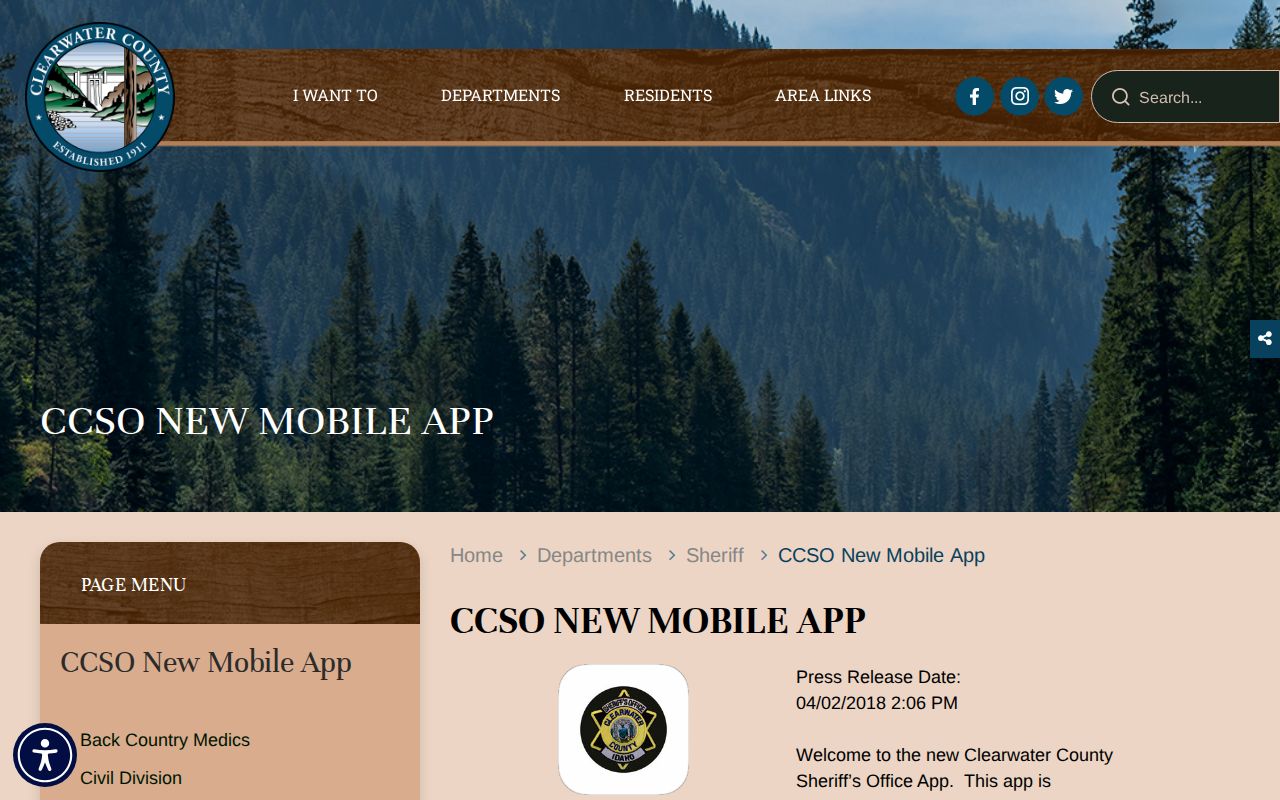
Its feature list supports public-safety alerts and reports, not a released-inmate mugshot archive.
Match Clearwater Photos to Releases
Requesting the booking photo and movement entry together creates a clean chain. The photo identifies the intake image. The movement entry states what happened at the end of the custody episode. Useful fields include booking number, admission date, release date and time, release reason, destination, receiving agency, and related case number.
A bond release does not dismiss the case. A time-served release relates to sentence credit or completion. A transfer to IDOC or another agency ends the county booking without placing the person in the community. The image looks the same in each situation, which is why it cannot carry the release meaning by itself.
If the photo concerns a state commitment rather than a county booking, use IDOC. Compare the IDOC number, birth year, status, offenses on active sentences, and sentence fields. A county photo and an IDOC identification image may come from different custody episodes.
Clearwater Photo Request Timing
Idaho Code §74-102 permits inspection, copies, and requested certified copies of public records, subject to exemptions. An agency may require a written request that describes the subject and date range. It may also require contact information and an Idaho-residency declaration. Email requests and delivery are allowed under the current framework.
For an Idaho resident, the general fee structure provides the first two labor hours and first 100 paper pages without a fee unless another law applies. Qualifying work beyond those thresholds can be charged at actual allowable cost using the lowest-paid qualified employee. Advance payment and an itemized estimate may be required. Nonresident requests may be charged actual costs under the amended rules.
These are statutory parameters, not a promise that every Clearwater booking photo will be free or disclosed. Ask the Sheriff to identify the exemption and review path in a written partial or full denial.
Clearwater Court Shielding Limits
Idaho Clean Slate relief is limited. The instructions describe a petition for qualifying nonviolent and non-assaultive records after at least five years from completion of the whole sentence, including supervision, fines, and restitution. Other statutory conditions apply, including the offense or incident limits and a lifetime limit on granted petitions.
Shielding prevents public court access; it does not destroy the record. Court Administrative Rule 32 also protects specified material, including presentence investigation reports and pretrial risk assessments. Since the September 2025 iCourt change described in the research, even the sealed event may no longer appear in the public Portal. A missing case result therefore cannot establish that no arrest image or case ever existed.
Juvenile sealing and fingerprint or criminal-history relief follow separate provisions. Do not present them as a broad right to erase an adult Sheriff photo, IDOC record, or independent news report.
When correction is appropriate, send the controlling order or accurate booking details to the office that holds the image. Keep the written response and the date sent. Independent publishers must be contacted separately because an agency correction does not automatically revise every copied photograph. The originating booking and court records remain the best sources for explaining the image and later case outcome.
Verify Clearwater Photo Identity
A booking photo should be matched through record identifiers, not visual resemblance. Begin with the full name, booking number, approximate arrest date, arresting agency, and related Clearwater County case number. If the Sheriff supplies the image with a booking sheet, keep those records together. Names alone can produce a false match.
For an IDOC image, compare the IDOC number and birth year in Resident/Client Search. The state result may also show status and active-sentence case information. An IDOC photograph can relate to a later state commitment, while the Sheriff image relates to the local booking. Treat them as separate records unless the identifiers connect them.
VINE may help identify the custodian and custody event, but it is not the official photo archive. iCourt may establish the case and disposition, yet the clerk's index does not replace the agency that created the image. Each source should be used for the fact it controls.
If an official record contains a wrong image or identity mismatch, contact that custodian with the precise record and supporting details. IDOC provides a Request for Information route for public-display inaccuracies. Sheriff records questions go to the Clearwater County Sheriff's Office. A correction in one system may not automatically propagate to copied news or commercial pages.
Public Record Search
Sponsored Results